
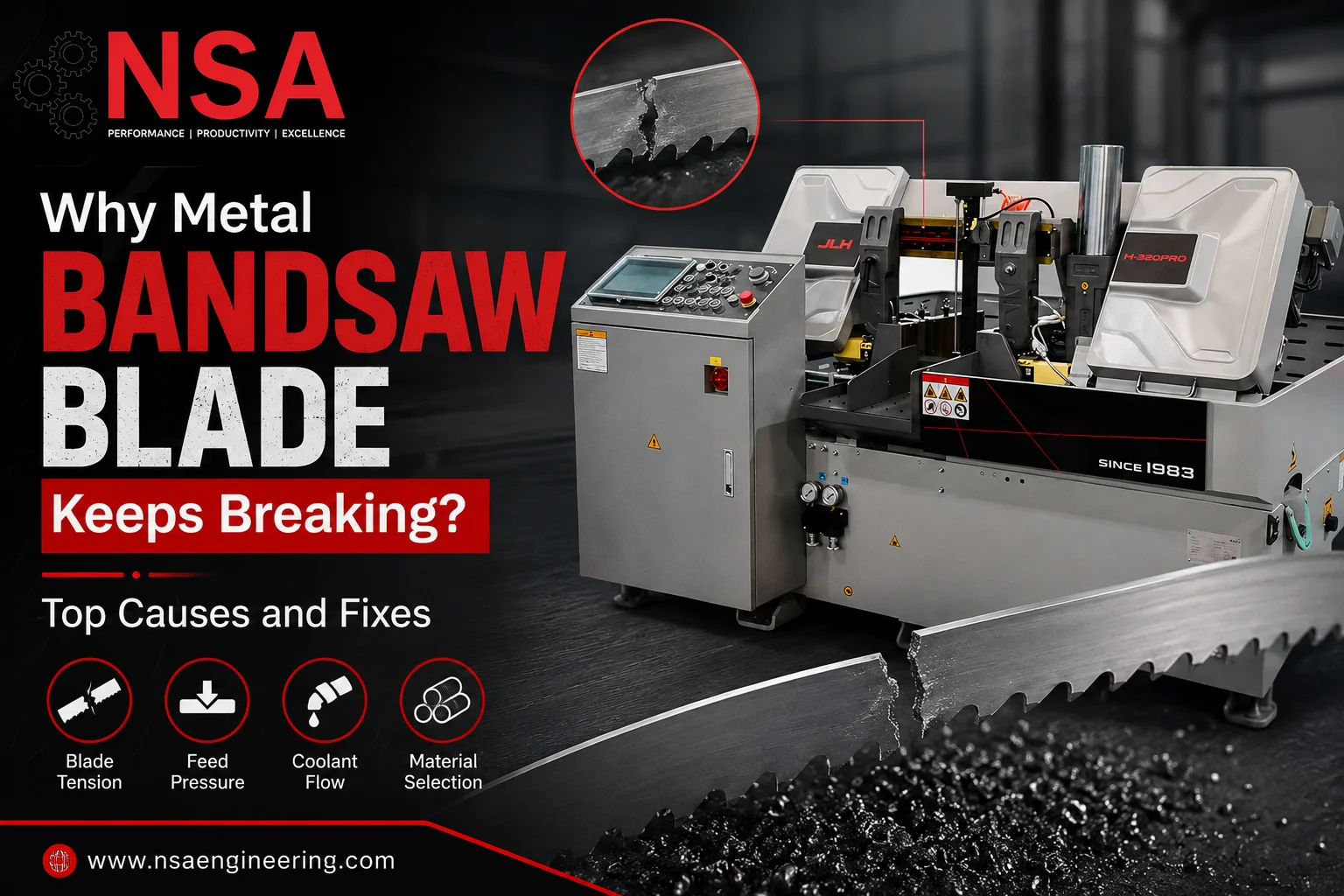
A malfunctioning bandsaw blade can stop production, lead to increased waste, and escalate operating costs. Repeated failure of the blade, whether during the cutting of mild, alloyed or hardened steel, must be an indication of some underlying problem and not a fault in the manufacturing. Knowing why a metal cutting bandsaw blade fails makes the first step towards improvement in cutting efficiency and blade lifetime. The following guide presents some of the most frequent causes of blade failure as well as the solutions that are most applicable.
Top Causes of Metal Bandsaw Blade Failure
Too tight or too loose blade tension
Blade tension that is either too tight or too loose affects not only the accuracy of the cut but also the wear of the blade.
Use of Irregular teeth pitch
When using a metal cutting bandsaw blade with a tooth pitch that is not suited for the material being cut, there is an increased chance of tooth loss, excessive vibration, and ineffective chip removal.
Excessive Feed Pressure
Pushing the blade through the material generates excess pressure and heat that cause damage to the teeth and shorten the life of the blade.
Wrong Speed
Selection of the wrong speed results in burning of the material if too fast or ineffective cutting if too slow.
Solutions for Each Problem
- Blade tension should be properly maintained following the guidelines provided by the manufacturer.
- The TPI should be chosen based on the thickness of the material being cut.
- Cutting should not be forced and the cutting pressure should be constant instead.
- Blade speed must be changed according to the type of material being cut.
- Alignment of the wheel must be checked and adjustments made to keep proper blade tracking.
- New blades must be broken in before production.
- Debris, chips and other wastes must be cleaned from the blade and the machine after use.
- Worn-out guides and faulty machine parts must be replaced on time.
- On manual saws, getting these right depends on the operator, every single time.
- On automatic machines with hydraulic controls, they’re held at a fixed, repeatable setting no matter who’s running the shift.
Bandsaw Blade Failure Causes and Fixes Overview
| Symptom | Likely Cause | Fix |
| Blade snaps at the weld | Weak or old weld, blade fatigue | Replace blade, check weld quality on new stock |
| Breaks near the start of a cut | Blade tension too high or too low | Re-tension to manufacturer spec |
| Cracks along the blade back | Wheel misalignment or worn guides | Realign wheels, inspect/replace guides |
| Teeth strip or blade snaps mid-cut | Wrong TPI for material thickness | Match TPI to stock size |
| Frequent breakage on hard metals | Blade speed too high, wrong blade type | Slow feed rate, switch to bi-metal or carbide blade |
Conclusion
Most blade failures can be avoided by following the proper machine setup and the mandatory maintenance routine. A proper cutting speed, correct feed rate, and high-quality metal cutting bandsaw blade will result in better cutting performance, less downtime, and long blade life.
At NSA Engineering, we provide certified bandsaw machines with appropriate blade sizes for a variety of metal cutting operations. Get in touch with our team to buy the cutting solution for your project.
FAQs
Based on metal thickness, the teeth per inch (TPI) must be selected. Thin metals require higher TPI, while thick ones need lower TPI.
Improper tensioning, incorrect running speed, feed pressure, and excessive vibration commonly cause metal cutting blades to break.
The signs of a bad bandsaw blade are tooth jamming, uneven cuts, microcracks and fractures.
Bi-metal bandsaw blades are considered the best for metal cutting. Carbon tipped are suitable for alloys and more heavy duty operations.
When you notice dull teeth, poor cut quality, missing teeth, or visible cracks, you should replace your metal cutting blade.